
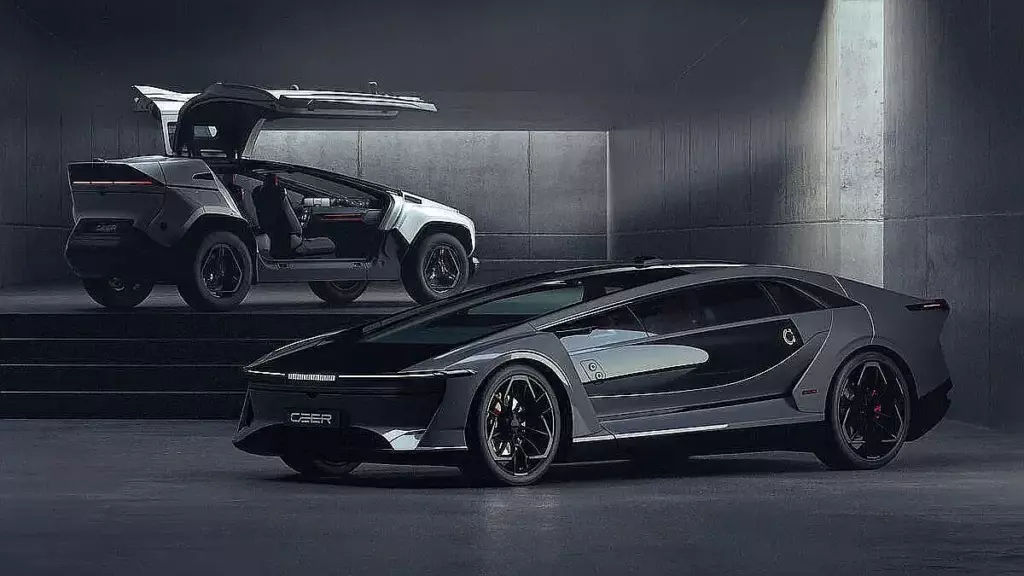
For decades, Saudi Arabia’s name has been synonymous with oil, not electric vehicles. But on September 21, 2026, Crown Prince Mohammed bin Salman personally unveiled two machines that signal a seismic shift in the Kingdom’s industrial ambitions. The Exobot sedan and SUV—the first production vehicles from Ceer Automotive—are not cautious entry-level EVs. They are 850-horsepower, gullwing-doored, 48-inch-screened declarations of intent. And they represent one of the most strategically complex automotive ventures of the decade.
The Machine: Radical Design Meets Serious Hardware
The Exobot is built on a shared 800-volt architecture, with both the sedan and SUV measuring over five meters in length. The sedan stretches to 5,260 mm, while the SUV comes in at 5,016 mm. Both ride on a 3,200 mm wheelbase and feature a tri-motor all-wheel-drive system producing 850 horsepower and 1,000 Nm of torque in the launch First Edition specification.
The headline performance figures are genuine hypercar territory: the sedan accelerates from 0 to 100 km/h in 2.6 seconds, while the heavier SUV does it in 2.9 seconds. A 112 kWh NCM battery provides a claimed NEDC range of up to 670 km for the sedan and 560 km for the SUV, with 10-80% charging achievable in under 30 minutes at up to 250 kW.
But it is the design that will stop traffic. Both vehicles feature a wedge-shaped profile, a 2.4-meter windshield described as the largest ever fitted to a production car, and Shahin Wing Doors—nearly three-meter-long gullwing panels that open upward in a 60-centimeter arc. The name references the Shahin falcon, a national symbol of Saudi Arabia. There is no B-pillar; structural rigidity is maintained through high-strength materials.
 The Interior: A Screen-First, Heat-Ready Cockpit
Inside, the Exobot continues the radical approach. A 48-inch 8K curved display spans the full width of the dashboard, supplemented by a 10.4-inch central touchscreen and an 8-inch rear-seat display. The steering is a yoke-style wheel with steer-by-wire technology, and rear-wheel steering is standard.
Perhaps most tellingly for a vehicle developed in the Arabian Peninsula, Ceer engineered a proprietary Halo Cooling system. According to the company, it can reduce cabin temperature from 65°C to 32°C within 10 minutes—a critical capability in a region where summer temperatures routinely exceed 50°C. Special heat-reducing glass and dual front-and-rear air conditioning systems complement the cooling strategy.
The Collaborators: A Global Supply Chain Behind a National Brand
Despite being billed as Saudi Arabia’s first homegrown car, the Exobot is a triumph of strategic partnerships. Ceer itself is a joint venture between Saudi Arabia’s Public Investment Fund (PIF) and Taiwanese manufacturing giant Foxconn.
The technical contributions read like a who’s-who of global automotive expertise:
| Partner | Contribution | Strategic Significance |
|---|---|---|
| Foxconn | Electrical/electronic architecture, platform development | Brings Apple-grade manufacturing discipline and EV platform expertise |
| BMW | Engineering support and technology licensing | Provides 100+ years of automotive engineering credibility |
| Rimac Technology | Rear electric drive unit | Croatian hypercar expertise in high-performance EV powertrains |
| Hyundai Transys | Front electric motors | Mass-production EV component reliability |
| Rob Melville | Exterior and interior design | Former McLaren Design Director (P1, Speedtail, Senna) |
The involvement of Rimac Technology is particularly notable. The Croatian firm, best known for its Nevera hypercar, signed the Ceer contract in October 2024—its first major customer from the Gulf region. The rear motors are produced at Rimac’s automated facility in Zagreb, marking a significant expansion from exclusive hypercars into volume industrial projects.
The Strategy: Vision 2030 and the Post-Oil Imperative
To understand why Saudi Arabia is building electric cars, one must look beyond the vehicles themselves. The Exobot is a flagship project of Vision 2030, the Kingdom’s sweeping strategy to reduce economic dependence on hydrocarbons.
The numbers behind the ambition are staggering. Ceer aims to contribute $8 billion to Saudi GDP by 2034. Production will take place at the Ceer Manufacturing Complex in King Abdullah Economic City, positioned as the largest automotive production facility of its kind in the Middle East and one of the most highly automated in the world.
The company plans to achieve 45% local parts content by 2034, supported by a growing network of international suppliers—including US firm Lear, Korea’s Shin Young, Germany’s Benteler, and China’s Fangxin—that have established Saudi factories to serve the project.
Beyond the initial Exobot duo, Ceer has outlined an aggressive roadmap: five additional models between 2028 and 2030, spanning mid-size and compact segments, with powertrain options extending beyond pure electric to include plug-in hybrids and combustion engines. The goal is a seven-model portfolio by 2030, designed to meet global regulatory requirements for potential export beyond the Gulf region.
The Reality Check: Challenges on the Road Ahead
Ambition, however, does not guarantee success. Ceer faces a daunting competitive landscape. Chinese manufacturers now lead the world in EV development and cost efficiency, and traditional automakers are pouring billions into electrification.
Saudi Arabia’s automotive history is littered with abandoned projects: a proposed Jaguar Land Rover factory was shelved over a decade ago, and Toyota declined a manufacturing deal in 2019, citing high labor costs and insufficient local suppliers. The difference this time, Ceer argues, is a broader approach—leveraging global partners while simultaneously building a local supplier ecosystem, backed by PIF’s virtually unlimited resources.
There is also the question of range figures. The claimed 670 km and 560 km ranges are measured on the NEDC cycle, an outdated standard known to be significantly more optimistic than the modern WLTP or EPA protocols. Real-world range will almost certainly be lower, though the 112 kWh battery capacity provides a solid foundation.
The Ceer Exobot is many things simultaneously: a technological showcase, a national statement, and a high-stakes industrial gamble. Its 850-horsepower tri-motor powertrain, radical gullwing design, and 48-inch digital interface place it firmly in the premium segment. But its true significance lies not in what it is, but in what it represents—Saudi Arabia’s most serious attempt yet to diversify beyond oil and claim a place in the global automotive industry. Production begins in January 2027 at King Abdullah Economic City, with customer deliveries targeted for March. Whether the Exobot becomes a symbol of successful transformation or a cautionary tale of overreach will depend on execution, market reception, and factors far beyond the car itself.
For readers who hold digital assets and travel across the region, a crypto visa card can be a practical way to pay abroad.





1 Comment. Leave new
🛢️ The Oil Paradox: Why Saudi Arabia Is Building EVs Faster Than Detroit
There is a profound irony at the heart of the Ceer Exobot. The world’s most oil-dependent economy is investing billions to build electric cars—the very technology designed to make its primary export obsolete. But this is not a contradiction; it is a calculated hedge. Saudi Arabia has watched the global energy transition accelerate and understands that its window to diversify is closing. Vision 2030 is not a climate initiative; it is an economic survival strategy. The Exobot, with its 850 horsepower and radical design, is the most visible manifestation of that strategy to date.
What makes this project different from previous Saudi automotive ambitions is the intellectual honesty embedded in the partnership model. Instead of trying to reinvent every component internally, Ceer assembled a global brain trust: Foxconn for electronics, BMW for engineering, Rimac for powertrain, Hyundai for motors, and a McLaren veteran for design. This is not national pride masquerading as industrial policy. It is a pragmatic acknowledgment that Saudi Arabia lacks automotive DNA—and a decision to rent it rather than spend decades developing it from scratch. The $8 billion GDP contribution target by 2034 suggests the PIF views this as infrastructure investment, not just a car company.
The Takeaway: The Exobot is not competing with Tesla or BYD. It is competing with the entire concept of Saudi economic irrelevance in a post-oil world. If it succeeds, it becomes a template for every resource-dependent nation facing the same existential calculus. If it fails, it will be studied as a case of capital without competence. The early signs—particularly the strategic depth of the partner network—suggest the former is more likely.
For readers tracking global investment opportunities and seamless cross-border transactions, crypto visa card provides a modern financial tool for the digital age.
Hashtags: #CeerExobot #SaudiEV #Vision2030 #PostOilEconomy