
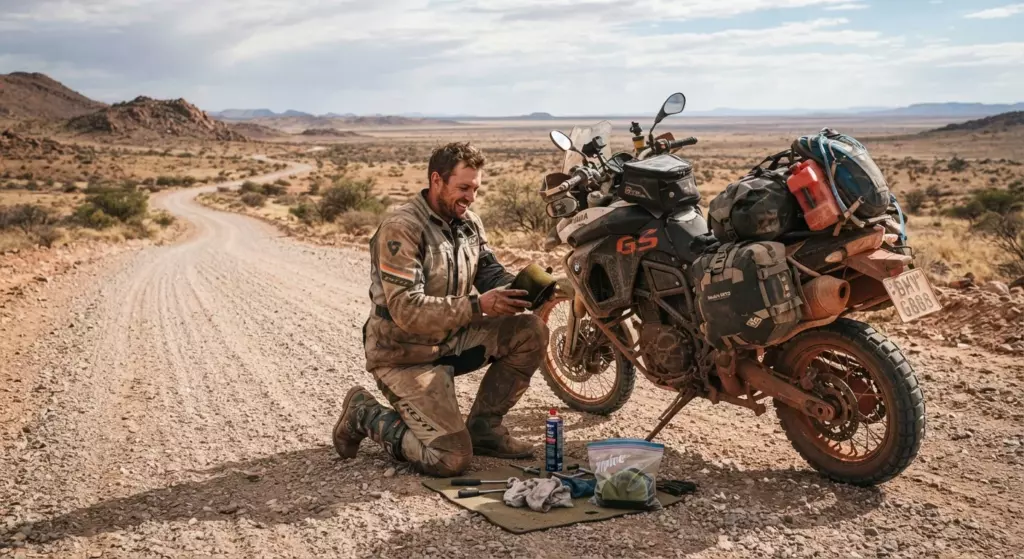
Hey fellow riders! If you have ever dreamed of pointing your front wheel toward the endless horizons of Southern Africa, you know the thrill is unmatched. Last month, I decided to trade coastal asphalt for the red dunes of Namibia and the rugged, sun-baked trails of the Karoo. Before hitting deep sand and corrugated gravel roads, though, I quickly realized that preparing a motorcycle for the desert is a completely different game.
When I first started mapping out this expedition, I spent days researching options for a reliable motorcycle rental in south africa to find a tough dual-sport machine built for long-distance abuse. Starting your trip from the coast makes logistics much easier, and going with a trusted motorcycle rent cape town provider gave me a solid foundation with fresh sprockets and a bash plate already installed. Still, even when you use a top-tier motorbike hire cape town service, desert riding demands extra personal preparation. Fine dust gets into every crevice, temperatures swing wildly from scorching afternoons to freezing nights, and the nearest mechanic can be hundreds of kilometers away.
Here is my personal checklist that kept both me and my bike running smoothly out in the bush:
1. Air Filtration is Everything
Desert dust is practically microscopic and will wreck a piston in no time. Before leaving civilization, I swapped out the standard filter for an oiled foam setup and packed a pre-oiled spare in a sealed Ziploc bag. Checking and swapping the air filter every couple of days became my evening ritual right after setting up camp.
2. Tires, Tubes, and Pressure
Deep sand and sharp rocks are a brutal combination. I insisted on aggressive knobby tires and upgraded to ultra-heavy-duty inner tubes. Lowering tire pressure to around 1.2 bar (17 PSI) gave me much better floatation in loose sand, though I always carried a compact 12V compressor to air back up for tarmac stretches.
3. Smart Luggage Setup
Every extra kilogram makes picking up a dropped bike in soft sand ten times harder. I ditched rigid aluminum panniers—which can easily trap an ankle during a low-speed tip-over—and went with soft waterproof saddlebags, keeping heavy tools low and close to the frame.
4. Protection and Fluids
Radiator guards are non-negotiable when riding behind buddies kicking up stones. I also strapped an extra two liters of coolant and engine oil to my rack, alongside a three-liter hydration pack for myself.
If you are planning an epic overland adventure through motorbike rental cape town, taking a few extra hours to dial in your setup before leaving the city will save you massive headaches later. Pack light, check your bolts daily, and enjoy the ride of a lifetime. Stay safe out there, and see you on the dusty trails!




1 Comment. Leave new
🏜️ The Desert Preparation Paradox: Why the Cheapest Rental Bike Can Be the Most Expensive
Southern Africa’s rental market for dual-sport bikes is a textbook case of how preparation and fine print can transform a bargain into a liability. The advertised daily rate—often as low as €25–40—is designed to attract clicks. But the real cost emerges once you leave the tarmac: dust ingress, tire damage, and the nearest mechanic being hundreds of kilometers away determine what you actually pay if something goes wrong. The checklist is revealing: air filtration sounds like a minor detail until you realize a clogged filter can wreck a piston in no time. Tire and tube protection is often overlooked entirely, which is a particular risk on Namibia’s gravel and the Karoo’s corrugated tracks where sharp rocks are common.
The strategic insight here is that preparation is not a commodity—it is a negotiation with the terrain. The cheapest base rate often comes with the most basic setup, while a slightly higher rate with a properly prepped machine (oiled foam filter, heavy-duty tubes, soft luggage) can be the smarter financial choice. The article’s advice to dial in your setup before leaving the city is exactly right, but it undersells the importance of daily checks. The most common failures—clogged filters, punctures, loose bolts—are precisely the ones most often ignored. Riders who skip this step are essentially self-insuring without knowing it.
The Takeaway: In Southern Africa’s desert rental market, the cheapest daily rate is rarely the best deal. The real price is the sum of the preparation, the spares, and the daily checks. Prep before you ride—or pay the price in the bush.
Hashtags: #DesertRiding #BikePreparation #SouthernAfrica #OverlandAdventure