
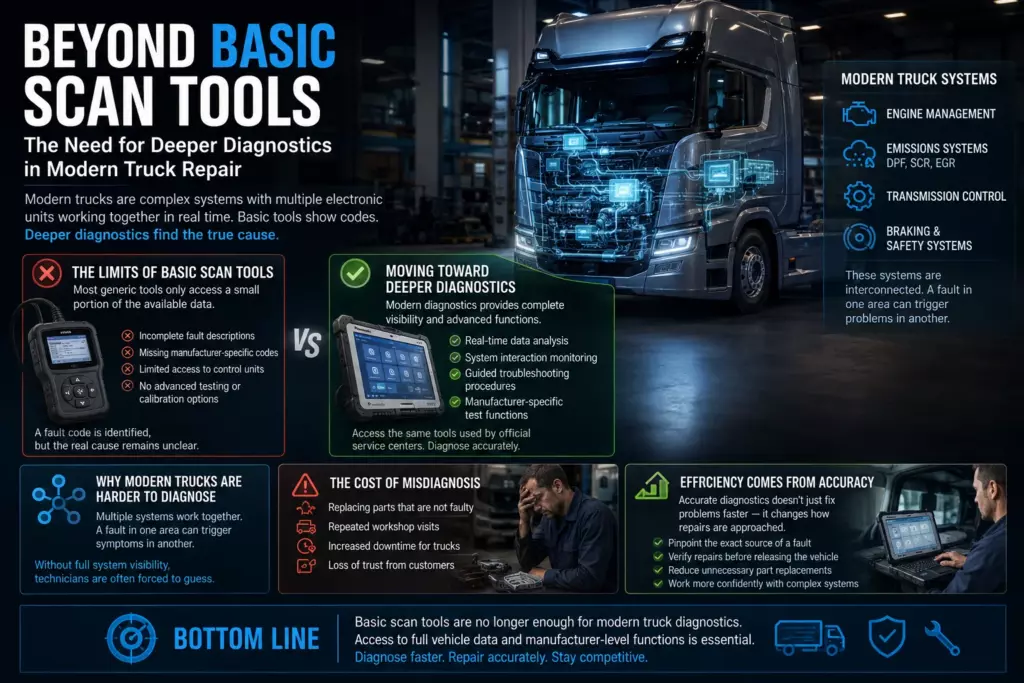
Modern trucks are no longer simple mechanical machines. Over the last decade, they’ve evolved into highly complex systems controlled by multiple electronic units working together in real time.
For many workshops, this creates a gap between what traditional scan tools can show and what’s actually happening inside the vehicle.
Basic scanners still have their place. They can read fault codes, clear errors, and provide limited live data. But when it comes to diagnosing deeper issues, especially in heavy-duty trucks, they often fall short.
The Limits of Basic Scan Tools
Most generic tools are designed to be universal. That sounds like an advantage, but in practice it means they only access a small portion of the available data.
Technicians using entry-level tools often run into problems like:
- incomplete fault descriptions
- missing manufacturer-specific codes
- limited access to control units
- no advanced testing or calibration options
This leads to a familiar situation: a fault code is identified, but the real cause remains unclear.
Why Modern Trucks Are Harder to Diagnose
Heavy-duty trucks today rely on multiple interconnected systems:
- engine management
- emissions systems (DPF, SCR, EGR)
- transmission control
- braking and safety systems
These systems don’t operate independently. A fault in one area can trigger symptoms in another, making diagnosis more complicated than simply reading a code.
Without full system visibility, technicians are often forced to guess.
Moving Toward Deeper Diagnostics
This is where the industry has shifted.
Instead of relying only on fault codes, modern diagnostics focuses on:
- real-time data analysis
- system interaction monitoring
- guided troubleshooting procedures
- manufacturer-specific test functions
Using proper dealer-level diagnostic software allows technicians to access this deeper layer of information. It provides the same tools used by official service centers, making it possible to identify issues accurately rather than relying on trial and error.
The Cost of Misdiagnosis
When diagnostics are limited, mistakes become expensive.
Common outcomes include:
- replacing parts that are not faulty
- repeated workshop visits
- increased downtime for trucks
- loss of trust from customers
In fleet operations, even small inefficiencies scale quickly. One incorrect repair can affect scheduling, delivery timelines, and overall operating costs.
Efficiency Comes From Accuracy
Accurate diagnostics doesn’t just fix problems faster — it changes how repairs are approached.
Technicians can:
- pinpoint the exact source of a fault
- verify repairs before releasing the vehicle
- reduce unnecessary part replacements
- work more confidently with complex systems
Over time, this leads to more efficient workshops and better results for both technicians and operators.
Bottom Line
Basic scan tools are no longer enough for modern truck diagnostics.
As systems become more advanced, the ability to access full vehicle data and manufacturer-level functions is essential. Workshops that adapt to this reality are able to diagnose faster, repair more accurately, and stay competitive in an increasingly technical industry.


1 Comment. Leave new
🔧 The Hidden Cost of “Good Enough” Diagnostics
This article makes a compelling case that basic scan tools are obsolete for modern heavy-duty trucks. But the deeper issue is economic. Workshops that stick with generic tools aren’t just risking misdiagnosis—they’re bleeding money on every repair. The article mentions “replacing parts that are not faulty” as a common outcome, but what it doesn’t spell out is the scale: in fleet operations, one incorrect DPF replacement can cost thousands in parts and labor, plus days of downtime for a truck that generates revenue on every mile.
The real competitive advantage described here is not just about having better software. It’s about shifting from reactive to predictive maintenance. When technicians can access dealer-level data, they stop guessing and start understanding the relationships between systems. That allows them to catch issues before they become failures, schedule repairs during planned downtime, and extend component life cycles. The workshops that invest in this capability aren’t just fixing trucks faster—they’re fundamentally changing their value proposition to fleet customers.
The Takeaway: In the age of connected trucks, “good enough” diagnostics is a competitive disadvantage. Workshops that embrace full-system visibility will become the trusted partners for fleets, not just the vendors who handle breakdowns.
Hashtags: #TruckDiagnostics #HeavyDuty #FleetMaintenance #DealerLevelSoftware