
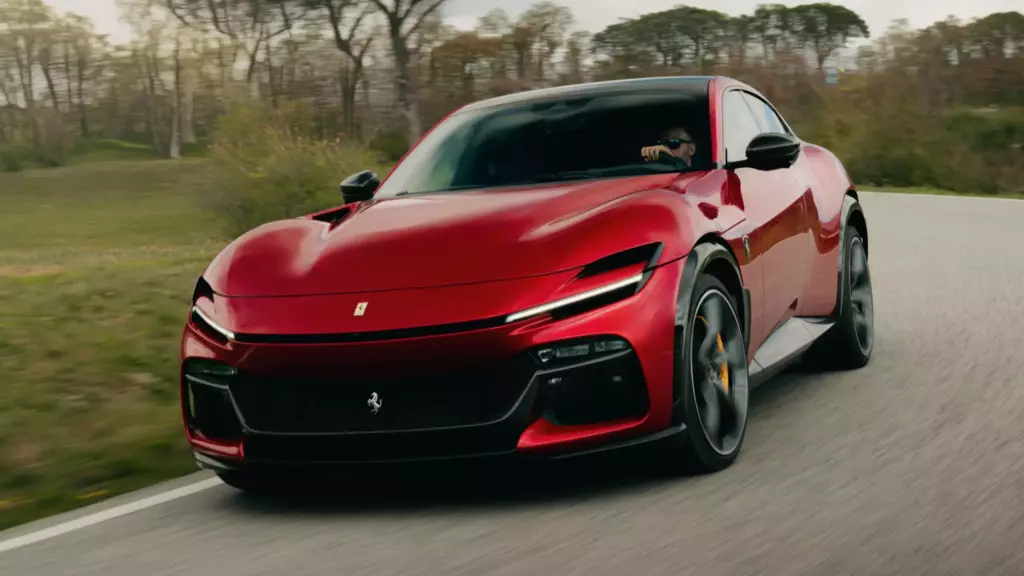
Ferrari spent decades building some of the world’s most recognizable sports cars, but one category remained conspicuously absent from its lineup: the SUV. That changed with the arrival of the Ferrari Purosangue. Yet even Ferrari was reluctant to describe its first high-riding, four-door production model as a conventional SUV. The reason becomes clear once you look beyond its increased ground clearance and four-seat layout. Under the hood sits a naturally aspirated 6.5-liter V12, while the chassis and drivetrain are engineered with the priorities of a genuine Ferrari rather than those of a traditional utility vehicle.
The Purosangue is therefore an unusual proposition. It offers the space, access and everyday usability expected from a high-performance SUV, but its proportions, driving position and mechanical character set it apart from vehicles such as the Lamborghini Urus, Aston Martin DBX and Porsche Cayenne. Ferrari‘s objective was not simply to build an SUV with a Ferrari badge. Instead, the Purosangue attempts to create a new type of four-door Ferrari.
 A V12 at the Heart of the Purosangue
The most important technical feature is undoubtedly the engine. The Purosangue uses Ferrari‘s naturally aspirated 6.5-liter V12, producing 725 cv (715 hp) at 7,750 rpm and 716 Nm of torque at 6,250 rpm. It revs to around 8,250 rpm, preserving the high-revving character that has defined Ferrari‘s V12 grand tourers and sports cars.
Power is sent through an eight-speed dual-clutch automatic transmission. Ferrari also uses a sophisticated four-wheel-drive system, with the front axle receiving power through a dedicated system at low and medium speeds while the rear axle is driven through the main transmission. This arrangement allows the Purosangue to deliver all-weather traction without adopting the conventional mechanical layout of many SUVs.
Performance is accordingly serious. Ferrari quotes 0-100 km/h in approximately 3.3 seconds and a top speed above 310 km/h. The figures place the Purosangue firmly in supercar territory, despite its four doors and relatively practical body.
Its chassis technology is equally significant. Ferrari developed an active suspension system using Multimatic True Active Spool Valve technology, allowing the car to control body movements without relying on conventional anti-roll bars. This is particularly important for a vehicle that needs to combine high-speed cornering with a more comfortable ride than a low-slung sports car.
The result is a car that is high-riding, but not soft or disconnected. Its engineering is closer to a grand tourer with additional versatility than to a conventional SUV.
A Different Interpretation of Ferrari Design
The exterior design reinforces that distinction. Rather than using the tall, upright proportions associated with most SUVs, the Purosangue has a long hood, low roofline and relatively compact glasshouse. Its body sits noticeably higher than a Ferrari sports car, but the overall silhouette remains distinctly GT-like.
One of its most recognizable features is the rear-hinged rear doors. Combined with the conventional front doors, they create a distinctive four-door configuration that improves access to the rear seats while allowing Ferrari to maintain a relatively clean side profile.
Inside, the Purosangue continues the unconventional approach. Instead of treating the rear seats as occasional accommodations, Ferrari designed the cabin as a genuine four-seat environment. Each passenger gets an individual seat, and the interior can be specified with a variety of leather, trim and personalization options.
The dashboard architecture is also unusual. Ferrari separates the driver’s and passenger’s environments, giving the front passenger a dedicated display that can show performance and vehicle information. The result feels more like a luxury performance car than a family SUV.
Practicality, Comfort and Luggage Space
Practicality is one of the areas where the Purosangue genuinely differs from Ferrari‘s traditional two-seat models. There are four proper seats, and the rear doors make access significantly easier than it would be in a two-door grand tourer.

The rear seats provide reasonable space for adults, although the sloping roofline means the Purosangue does not offer the same boxy interior volume as a conventional luxury SUV. The seating position is also lower than in many rivals, reinforcing Ferrari‘s decision to prioritize driving dynamics.
The luggage compartment offers around 473 liters of capacity, which is useful for weekend travel and everyday errands. The rear seats can be folded when additional carrying capacity is required.
This makes the Purosangue surprisingly usable as a daily vehicle. It can accommodate passengers, luggage and longer journeys without requiring the compromises associated with a traditional supercar.
However, practicality has limits. If maximum cargo volume, towing capability or a genuinely elevated driving position are priorities, a conventional SUV remains more suitable.
The Purosangue in Context: A New Segment
The Purosangue enters a rarefied segment where it competes not just on performance, but on character. To understand its unique position, consider how it compares to its closest rivals:
| Model | Engine | Power | 0-100 km/h | Starting Price (approx.) |
|---|---|---|---|---|
| Ferrari Purosangue | 6.5L naturally aspirated V12 | 715 hp | 3.3 sec | €390,000 |
| Lamborghini Urus Performante | 4.0L twin-turbo V8 | 657 hp | 3.3 sec | ~€260,000 |
| Aston Martin DBX707 | 4.0L twin-turbo V8 | 697 hp | 3.3 sec | ~€250,000 |
| Porsche Cayenne Turbo GT | 4.0L twin-turbo V8 | 640 hp | 3.3 sec | ~€200,000 |
The table reveals the Purosangue‘s unique selling proposition: it is the only vehicle in its class with a naturally aspirated V12. While rivals rely on turbocharging to achieve similar performance figures, Ferrari has chosen to preserve the emotional and mechanical character of its flagship engine.
Strengths and Weaknesses
The Purosangue‘s greatest strength is arguably its combination of characteristics. Few cars offer a naturally aspirated V12, four-wheel drive, four individual seats and genuine long-distance capability in one package. The engine provides an emotional and mechanical character that turbocharged alternatives cannot completely replicate.
Its handling is another major advantage. Ferrari has invested heavily in keeping the car responsive and controlled, and the relatively low body and sophisticated suspension give it a distinctly sporting character.
There are compromises, however. The most obvious is the price. The Purosangue starts at roughly €390,000 in European markets before extensive personalization and local taxes, and a well-optioned example can cost considerably more.
Running costs are also likely to be substantial. A large naturally aspirated V12 consumes significantly more fuel than smaller turbocharged engines, while tires, brakes, servicing and insurance reflect the car’s performance and exclusivity.
The other compromise is that the Purosangue does not provide the same level of utility as a conventional SUV. It has less cargo flexibility, limited off-road ambitions and a lower seating position. Its purpose is different.
Price, Options and Market Value
Ferrari‘s personalization program can have a major effect on the final price. Buyers can choose from extensive exterior colors, interior materials, carbon-fiber components, wheel designs and other factory options. As with other Ferrari models, a highly personalized specification can add a significant amount to the purchase price.
Market value is another interesting aspect. The Purosangue is produced in limited numbers relative to mainstream SUVs, and Ferrari has indicated that it would keep production below a certain proportion of its overall output. Its V12 configuration and unusual position within the Ferrari range may support strong demand over time.
That does not make it a guaranteed investment. Market values depend on specification, mileage, condition, supply and broader economic conditions. Buying one purely as a financial asset would therefore be difficult to justify. Its appeal is primarily as an exceptionally unusual Ferrari that can also be used regularly.
Experiencing a Purosangue Without Buying One
For most enthusiasts, the biggest obstacle is simply access. With a purchase price approaching half a million euros once options and taxes are considered, owning a Purosangue is beyond the reach of most drivers.
A rental can provide a more practical way to experience what Ferrari was trying to achieve. The Ferrari Purosangue can be rented through Lurento in Switzerland, Italy or Germany, depending on availability and rental conditions. For those interested, you can rent Ferrari Purosangue directly.
This type of experience can be particularly useful because the Purosangue‘s appeal is difficult to judge from specifications alone. Spending time behind the wheel allows drivers to experience its V12 engine, steering response, ride quality, rear-seat accessibility and everyday usability without committing to ownership. Rental conditions, mileage allowances, insurance requirements and availability naturally vary, so these details should be checked before booking.
The Ferrari Purosangue succeeds because it does not attempt to become a conventional SUV. Instead, it takes the practical advantages of the category—four doors, four seats, useful luggage space and all-weather traction—and combines them with the mechanical character and driving focus expected from Ferrari.
The naturally aspirated V12 remains the defining feature. In an automotive market increasingly dominated by turbocharging, electrification and downsized engines, the 6.5-liter engine gives the Purosangue a distinctive identity. At the same time, its sophisticated suspension, four-wheel-drive system and relatively practical cabin make it considerably easier to live with than a traditional Ferrari sports car.
The compromises are equally clear. The price is extremely high, running costs are substantial, and it cannot match a conventional luxury SUV for cargo capacity or utility. Yet those limitations are largely the consequence of Ferrari‘s decision to prioritize performance and character.
Ultimately, the Purosangue is best understood not as Ferrari‘s answer to the SUV, but as Ferrari‘s interpretation of what a four-door performance car can be. It is faster, more practical and more versatile than the company’s traditional sports cars, while remaining fundamentally different from the high-performance SUVs it competes with. That unusual balance—and the presence of a naturally aspirated V12 at its center—is what makes the Purosangue such an intriguing addition to Ferrari‘s history.



1 Comment. Leave new
🏎️ The Last of the Mohicans: Why the Purosangue’s V12 Matters More Than Its Doors
The automotive world has spent years debating whether the Purosangue is a “real” Ferrari. Purists argue that a four-door, high-riding vehicle betrays the marque’s DNA. But this debate misses the point entirely. The Purosangue‘s significance is not its body style—it is what sits under the hood. In an era where even Ferrari‘s own flagship supercars have adopted hybrid assistance, the Purosangue remains one of the last production vehicles in the world with a naturally aspirated V12. That is not nostalgia; it is a strategic statement.
Consider the competitive landscape. Every rival—the Urus, the DBX, the Cayenne—uses a twin-turbo V8. These engines are undeniably effective, delivering massive torque and impressive efficiency. But they lack the linear response, the escalating crescendo, and the sheer emotional theatre of a naturally aspirated twelve-cylinder. Ferrari understands that its customers are not buying mere transportation; they are buying an experience. The Purosangue‘s V12 is the ultimate differentiator, a mechanical signature that no turbocharged rival can replicate.
There is also a broader cultural dimension. The Purosangue arrives at a moment when the automotive industry is racing toward electrification. Governments are mandating zero-emission targets, and manufacturers are investing billions in battery technology. In this context, a new vehicle with a large-displacement, naturally aspirated V12 feels almost defiant. It is Ferrari‘s way of saying that while it will embrace the future, it will not abandon the past. The Purosangue is not a compromise; it is a celebration.
The Takeaway: The Purosangue‘s four doors are a practical feature. Its V12 is a cultural artifact. Decades from now, when electric SUVs are the norm, this car will be remembered not for its seating capacity, but for being one of the last great naturally aspirated Ferrari engines ever produced.
Hashtags: #FerrariPurosangue #V12 #NaturallyAspirated #Ferrari