
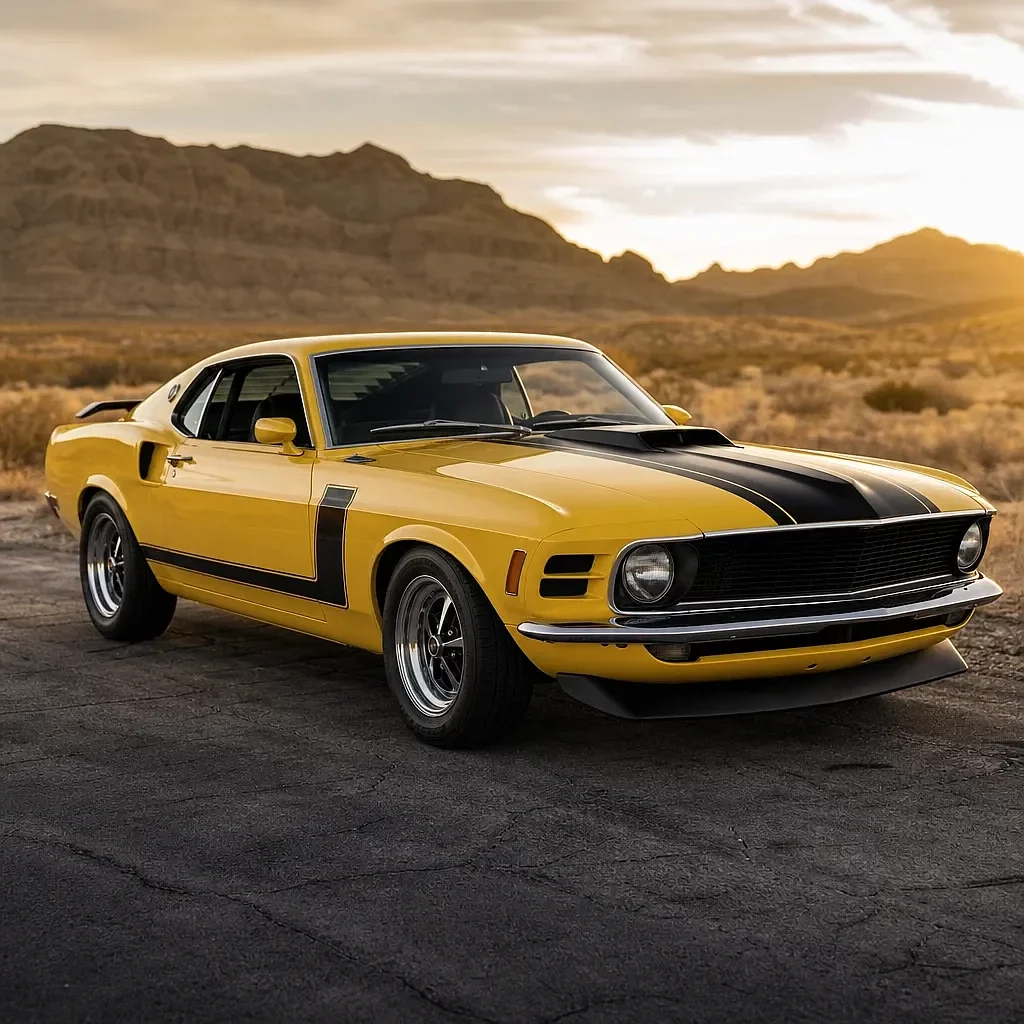
The Racing DNA Behind the Boss 302
Ford’s motivation for building the Boss 302 was not born from marketing ambition alone. The Trans-Am racing series required manufacturers to produce a minimum number of street-legal versions of their competition cars, and Ford needed a homologation special that could genuinely compete against the Chevrolet Camaro Z/28. The result was an engine that defied conventional wisdom — a small-block 302 cubic inch V8 that breathed through high-revving cylinder heads borrowed from the 351 Cleveland, producing a factory-rated 290 horsepower that most enthusiasts understood was a significant understatement.
The engine’s free-revving character was unlike anything else in the Mustang lineup. Where the big-block 428 Cobra Jet delivered its power in a broad, torque-heavy surge, the Boss 302 demanded to be driven hard and kept on the boil. It rewarded skilled drivers who understood how to extract performance through the rev range rather than simply planting their foot and waiting for the torque to arrive. This made it a fundamentally different driving experience — one that felt more European in its character than the typical American muscle car of the era.
What Changed in 1970: Refinement Over Revolution
The transition from the 1969 to the 1970 model year brought meaningful improvements rather than wholesale redesign. Ford’s engineers addressed several criticisms that had emerged from early owners and automotive journalists. The front suspension geometry was revised to improve high-speed stability, and the rear suspension received attention to reduce the wheel hop that had occasionally plagued the 1969 car under hard acceleration. These were not cosmetic changes — they represented genuine engineering responses to real-world feedback.
Visually, the 1970 Boss 302 adopted a cleaner, more integrated appearance. The hockey stick side stripes that had defined the 1969 car gave way to a revised graphic treatment that many collectors consider more elegant. The front end received updated styling consistent with the broader 1970 Mustang facelift, featuring a revised grille and repositioned headlights that gave the car a more aggressive, forward-leaning stance. Inside, the cockpit remained purposeful and driver-focused, with minimal luxury concessions that kept the car honest about its intentions.
Transmission and Drivetrain Choices
The standard transmission for the Boss 302 was the Hurst-shifted four-speed manual, widely regarded as one of the finest gearboxes available in an American production car during this period. The close-ratio version was particularly well-suited to the engine’s power band, allowing drivers to keep the revs in the optimal range through corners and on acceleration runs. A limited number of cars were delivered with the Ford C4 automatic, though purists generally consider the manual-equipped cars to be the definitive expression of the Boss 302 experience.
Revology Cars and the Art of Authentic Restoration
For collectors and enthusiasts who want to experience the Boss Mustang without the compromises that come with a fifty-year-old vehicle, Revology Cars has established itself as the definitive source for meticulously built continuation vehicles. Their approach combines period-correct aesthetics with modern engineering solutions that address the reliability and drivability limitations of original cars. If you are searching for a 1970 Boss Mustang 302 that delivers the authentic visual and emotional experience of the original while incorporating contemporary mechanical standards, Revology’s craftsmanship represents an exceptional solution for serious collectors who refuse to compromise on quality or authenticity.
The Boss 302 in Competition Context
On the Trans-Am circuit, the Boss 302 program delivered results that validated Ford’s investment. Parnelli Jones and George Follmer drove factory-backed Boss 302 race cars to victories that demonstrated the platform’s genuine competitive capability. The street cars benefited directly from this racing development, receiving components and calibrations that had been proven under the most demanding conditions imaginable. This direct lineage between race car and road car was something Ford actively promoted, and it gave the Boss 302 a credibility that purely marketing-driven muscle cars could never claim.
The legacy of that racing program continues to influence how enthusiasts and builders approach the Boss 302 platform today. Custom builds inspired by the original Trans-Am cars remain popular, with builders drawing on the original’s combination of light weight, balanced handling, and high-revving power. For those interested in how modern builders interpret this heritage, the Roush Stage III Mustang represents a fascinating contemporary parallel — a purpose-built performance variant that echoes the Boss 302’s philosophy of extracting maximum capability from a focused, driver-oriented package.
The Mustang Legacy Continues Into the Modern Era
The principles that made the Boss 302 exceptional — precise handling, a high-revving engine, and an uncompromising commitment to driver engagement — remain the foundation of Ford’s performance philosophy more than five decades later. The evolution of this thinking can be seen in how Ford approaches its flagship performance variants today. A recent detailed review of the 2026 Ford Mustang GTD illustrates just how far the platform has evolved while maintaining that core commitment to delivering a genuinely involving driving experience that rewards skill and attention.
The technological distance between a 1970 Boss 302 and a 2026 Mustang GTD is vast, yet the philosophical continuity is unmistakable. Both cars exist because Ford believed that a Mustang should be capable of embarrassing purpose-built sports cars on a road course, not merely winning stoplight drag races. That conviction, first expressed with genuine conviction in the Boss 302 program, remains the animating principle behind Ford’s most serious performance efforts.
Collectibility and Market Position
The 1970 Boss 302 occupies a unique position in the collector car market. Production numbers were relatively limited compared to standard Mustang variants, and the combination of racing heritage, distinctive styling, and genuine performance credentials has sustained strong collector interest for decades. Documented, numbers-matching examples in excellent condition command significant premiums, and the market shows no signs of softening as the generation of enthusiasts who came of age during the muscle car era continues to pursue the cars they remember most vividly.
What to Look for When Evaluating a Boss 302
Serious buyers should prioritize documentation above all else. A Marti Report — generated from Ford’s original production records — provides definitive confirmation of a car’s original specifications and build details. Engine stampings, VIN decoding, and door tag information should all align consistently. Given the values involved, professional inspection by a specialist familiar with Boss 302 specifics is not optional — it is essential. The market contains a significant number of tribute cars and clones, some built with genuine skill and others assembled opportunistically, and distinguishing between them requires expertise that casual observation cannot provide.
The 1970 Boss Mustang 302 earned its legendary status through performance rather than mythology. It was a car that delivered on its promises at the racetrack and on the street, offering a driving experience that rewarded engagement and skill in ways that few American cars of its era could match. Decades later, it remains one of the most compelling expressions of what the Mustang platform is capable of when Ford’s engineers are given a clear performance mandate and the resources to pursue it without compromise. For collectors, drivers, and enthusiasts alike, the Boss 302 represents a high-water mark that continues to define what a truly great American performance car should be.


1 Comment. Leave new
🏁 The Homologation That Defined an Era: Why the Boss 302 Still Matters
The 1970 Boss Mustang 302 represents something increasingly rare in automotive history: a genuine race car for the road, built not for marketing theater but for regulatory necessity. Ford’s Trans-Am homologation program created a machine that wasn’t softened for mass appeal — it was sharpened for competition, and that purity is precisely why it remains so revered. Unlike the era’s many “special editions” that were little more than decal packages, the Boss 302 received meaningful mechanical differentiation: unique cylinder heads, a specific camshaft profile, revised suspension geometry, and a transmission that actually suited its high-revving character.
What’s particularly significant about the 1970 model is the commitment to refinement. Ford didn’t just homologate and move on; they listened to feedback from early cars and made tangible improvements. The revised suspension geometry addressed real handling quirks, and the cleaner visual treatment suggests a design team confident enough to evolve rather than simply repeat. This iterative approach — building on success rather than resting on it — is what separates the 1970 car from its predecessor and elevates it to a different tier of collectibility.
The Takeaway: The Boss 302 endures not because it was the fastest muscle car in a straight line — it wasn’t — but because it was the most complete. It proved that American manufacturers could produce a car that rewarded skill, cornered with precision, and delivered an experience that transcended the typical muscle car formula. In an era when most performance cars were defined by their engines alone, the Boss 302 defined itself by its balance, feedback, and driver engagement. That legacy continues to influence how we evaluate modern performance cars, and it’s why the Boss 302 remains a benchmark — a reminder that true greatness isn’t about horsepower figures, but about how a car feels when you’re behind the wheel.
#HomologationHero #TransAmLegend #BalanceOverBruteForce