
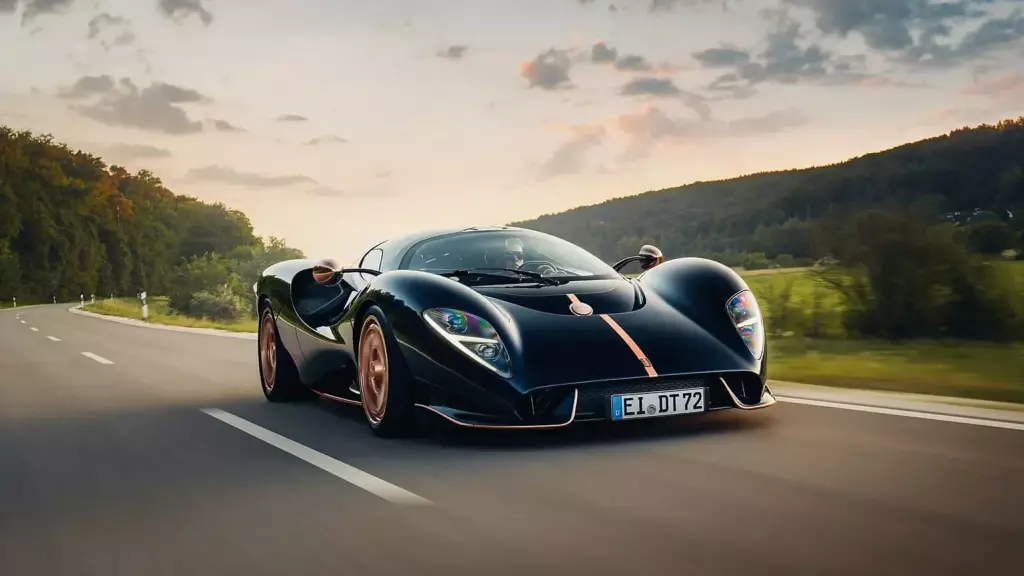
The resurrection of De Tomaso has been a slow burn. The Italian brand, revived in the late 2010s with backing from a Chinese holding group, first unveiled its P72 supercar back in 2019. Six years later, the first customer-commissioned example has finally emerged. Finished in a color-shifting black-to-blue hue with prominent rose gold accents, this machine is a rolling testament to bespoke automotive artistry. The official price remains undisclosed, but unofficial estimates place the starting cost at no less than $1.6 million before options and personalization.
Chameleon Paint and Precious Metal Accents
The chosen exterior color, named Aurelian Night, appears as a deep, almost mysterious black in most lighting conditions. But when direct sunlight hits the carbon-fiber bodywork, the paint transforms into a rich, vibrant blue. This chameleon effect is further amplified by strategic rose gold detailing.
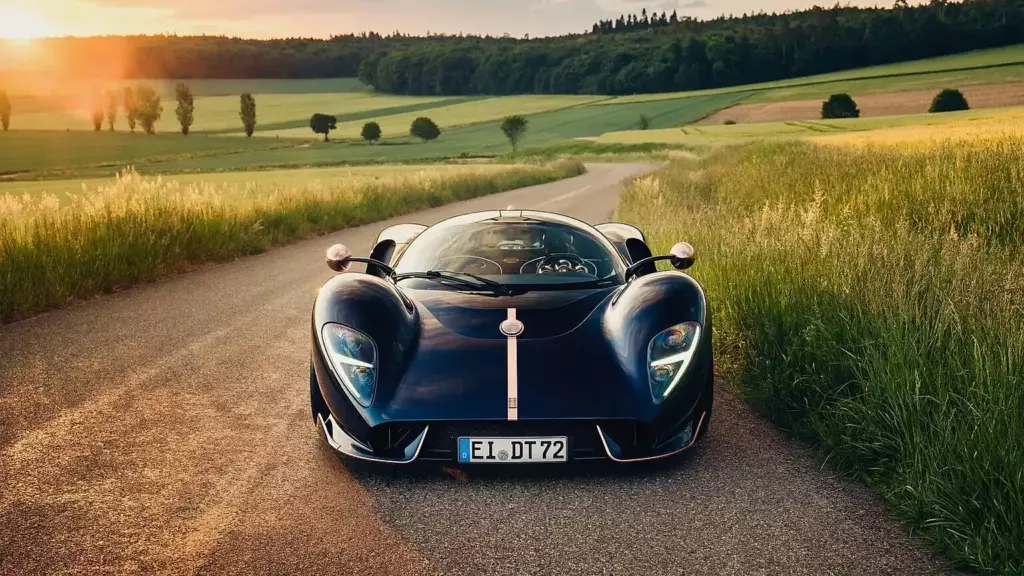
The Aurelian Night paint shifts from deep black to vibrant blue depending on the light.
The rose gold touches are applied to key aero elements: sections of the front splitter, air intakes, rear diffuser, a racing stripe running from nose to tail, and the most noticeable components—the wheels and side mirror housings. The effect is one of restrained opulence, a far cry from the matte black and exposed carbon that dominates the modern hypercar landscape.
A Cabin Clad in Blue and Rose Gold
The bespoke treatment continues inside, where rose gold accents are paired with Venetian Blue leather. The combination creates a cohesive, luxurious environment that echoes the exterior’s color story without overwhelming the senses.
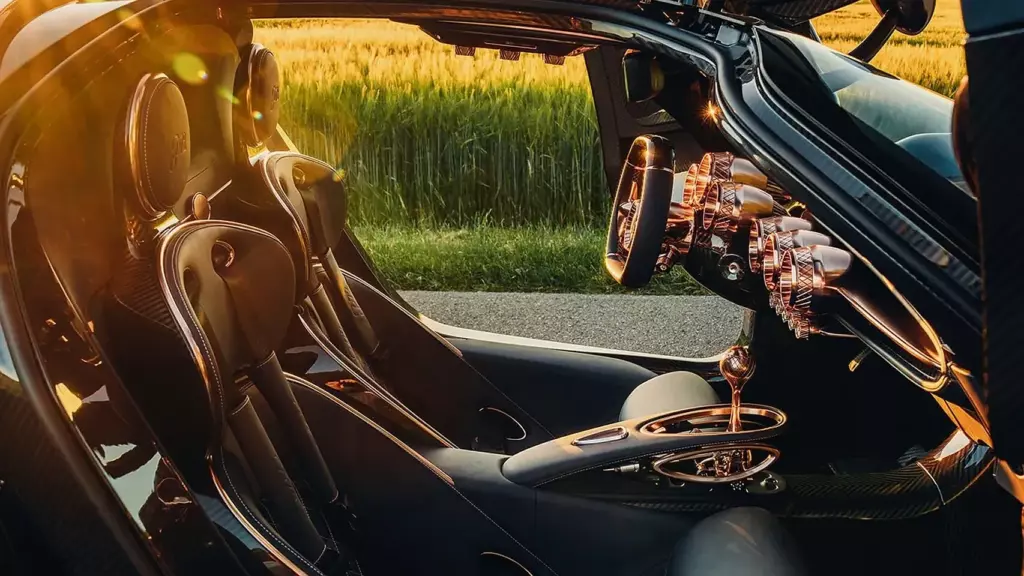
The cabin pairs Venetian Blue leather with rose gold accents, echoing the exterior theme.
De Tomaso P72: Core Specifications
- Chassis: Carbon fiber monocoque
- Engine: 5.0L supercharged Ford V8
- Power: 700 hp
- Torque: 820 Nm (605 lb-ft)
- Transmission: 6-speed manual (rear-wheel drive)
- Base Price (Estimated): $1.6 million+
- Launch: First shown 2019, first customer car 2025
The Last of the Analog Supercars
What makes the De Tomaso P72 truly remarkable in 2025 is not its power figure. At 700 horsepower, it is significantly down on the 1,000+ hp hybrids and EVs that dominate the performance conversation. Instead, its appeal lies in what it refuses to be.
The P72 features a carbon fiber monocoque—modern enough—but pairs it with a six-speed manual transmission driving only the rear wheels. This is a deliberate choice, a nod to the analog driving experience that defined the original De Tomaso Pantera. The supercharged 5.0-liter Ford V8, delivering a visceral 700 hp, is an engine that demands to be driven, not just guided by electronics.
Context: The Ultraluxury Manual Revival
The first customer P72 arrives in a small but fascinating micro-segment of ultra-expensive, driver-focused machines. To understand its positioning, it is worth comparing it to another recent debut: the one-off Miller JC9, a heavily reimagined Porsche Carrera GT.
| Characteristic | De Tomaso P72 | Miller JC9 |
|---|---|---|
| Base Platform | New carbon fiber monocoque (2019 design) | Porsche Carrera GT (1,270 units ever built) |
| Engine | 5.0L supercharged Ford V8, 700 hp | 5.7L naturally aspirated V10 (original Carrera GT) + potential upgrades |
| Transmission | 6-speed manual, RWD | 6-speed manual, RWD |
| Production | Limited series (exact number undisclosed) | Likely a single unit |
| Price Range | $1.6 million+ estimated | Multi-million (donor car + extreme customization) |
| Philosophy | Reborn brand with modern-retro design | One-off homage to a iconic V10 supercar |
Both the P72 and the JC9 represent a rejection of the autonomous, hybrid, hyper-digital future. They are aimed at collectors who value engagement over lap times, and for whom a manual transmission is not a compromise but the entire point.
With an estimated starting price of $1.6 million, the De Tomaso P72 enters a rarefied atmosphere reserved for the automotive elite. Yet even at this summit, there are different peaks. The P72’s value proposition hinges on analog engagement, a six-speed manual, and the romance of a resurrected Italian nameplate. A different, but equally compelling, approach to this tier of exclusivity can be seen in Bugatti’s Sur Mesure program, where a $5 million Mistral roadster like the one-off “Caroline” transforms hypercar ownership into an intimate family heirloom, complete with hand-painted lavender fields and wind-blown floral embroidery. Both machines reject the digital, autonomous future, but they speak to different facets of the collector’s soul: one is a raw, mechanical time capsule, the other a deeply personal, rolling work of art.
Six years after its initial reveal, the De Tomaso P72 is finally transitioning from concept to customer reality. With a price that likely starts at $1.6 million and climbs steeply from there, it will never be a volume seller. But that is not the point. The P72 exists to re-establish De Tomaso as a brand for connoisseurs—those who value rarity, analog engagement, and the ability to specify every last rose gold accent. In a market dominated by software-defined vehicles, the P72 is a defiantly hardware-focused artifact. Whether that is enough to sustain a revived brand remains to be seen, but as a first customer car, it makes an unforgettable statement.





1 Comment. Leave new
⏳ The Six-Year Gap: What the P72’s Slow Arrival Really Means
The headline story here is the car itself—the rose gold, the chameleon paint, the manual gearbox. But the more revealing story is the six-year gap between the P72’s unveiling in 2019 and the delivery of the first customer car in 2025. That timeline speaks to the immense difficulty of restarting a boutique automaker from scratch. Engineering a carbon-fiber chassis, securing supply chains, crash-testing, emissions certification—all while maintaining design purity and financial solvency—is a brutal undertaking. The fact that a customer car exists at all is a victory.
What is also notable is the price positioning. At an estimated $1.6 million base, the P72 competes directly with the Bugatti Chiron and Pagani Huayra in terms of exclusivity, but with a power figure (700 hp) that is closer to a Porsche 911 Turbo S. This is not a value proposition built on specs. It is built on scarcity, manual transmission romance, and the intangible allure of a resurrected Italian nameplate. De Tomaso is not selling performance per dollar; it is selling access to a very specific, very small club. The first customer car, with its coordinated rose gold and Venetian Blue theme, suggests the brand understands its audience perfectly: clients who want to dictate every visual detail, not just check boxes on a configurator.
The Takeaway: The P72’s slow, six-year journey to a customer’s garage is not a sign of failure—it is a feature of the business model. Ultra-low-volume production is not a bug; it is the entire point. De Tomaso is building fewer than 100 cars, and each one will be a rolling negotiation between the client’s imagination and the brand’s craftsmanship. The only deadline that matters is the client’s satisfaction, not the quarterly earnings report.
Hashtags: #DeTomasoP72 #AnalogSupercar #ManualTransmission #BespokeAutomotive